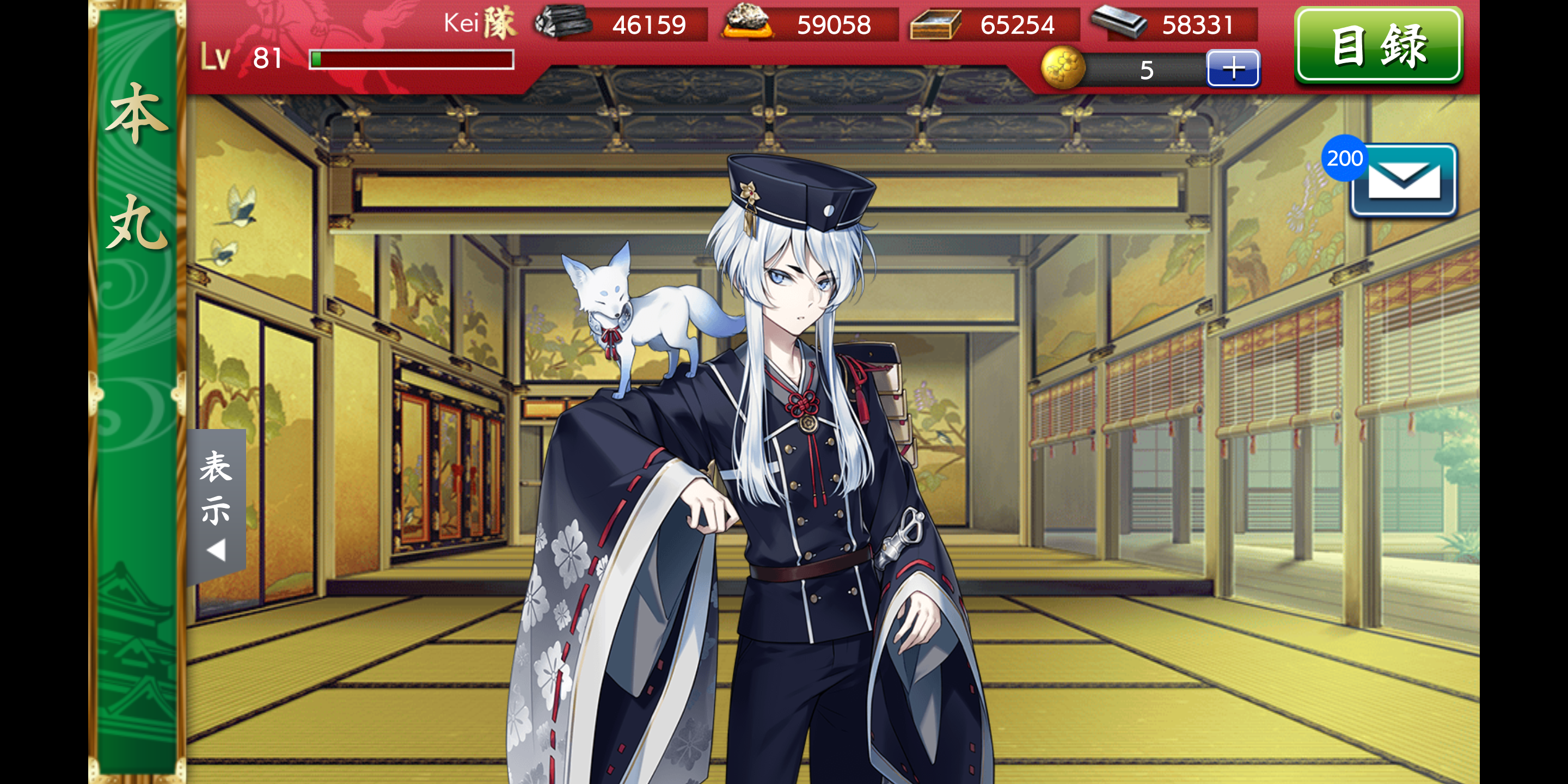
A different side of the Saniwa, or why is the worst character in the stageplays the one we are not even supposed to see.

Spoiler alert : I will be talking in depth about the four main stageplays and especially about the last one, Hiden yui no me no hototogisu. I will talk about the plot and characters so if you don’t want any spoilers, feel free to skip this post.

Now that the warning is out of the way, I would like to point out that usually my posts include research and following impersonal and objective path. I work with facts. This time, though, I am going to talk about my personal opinion when it comes to the Saniwa sage as shown in the first four stageplays which are the ones I have seen by this moment.

As you can clearly see from the title, I don’t have a very high opinion of that one particular individual based solely on the consequences of their decisions and actions. And those definitely do not fill me with determination.

Before we go further, I would like to talk a little about the Saniwa sage as canon. The Saniwa is the one who makes the decisions, chooses units, chooses battlefields and takes responsibility. You know how it is, we are all in the same boat as sages.

In the first anime, Touken Ranbu : Hanamaru, we never see the Saniwa who overlooks that citadel. In season one they are always a mysterious figure that remains unseen and we do get information about them only based on what the swords talk about. In the second season the characters do interact with the sage directly but because the anime is keeping with the canon, the viewer never sees the sage since they are supposed to be the sage.

Katsugeki : Touken Ranbu goes down a different path. They treat the Saniwa sage as simply another character which is why we see them exactly like that – a regular character. Not a main one but definitely one that is present throughout the show and really makes an impression. Look at this cutie.

I personally can only dream of being that cool. Anyway. In the original script the pronouns used to describe this individual are the Japanese equivalent of “they/them” keeping their gender not in question but more like unimportant. It doesn’t matter because they could be anyone. In the English translation when it comes to subtitles, the other characters refer to the Saniwa as “he/him” placing them in the same group as all the male characters.

Some versions of the stageplays feature a translation that refers to the Saniwa as “she/her” making them female while the tiny look we get of their silhouette suggests a much more imposing figure that resembles a man.

None of this is important to the plot but it’s an interesting bit of trivia.

Now, about the decision of the Saniwa in the stageplays. We do know, canonically, that there is a governing body that regulates the sages. Which is why there are variation of sages that work in each country and each time period. This can be seen in Hanamaru’s opening. A sage should work, on theory, only in specific country and send their Units only in a specific historical period. All this means that there is order, hierarchy and rules.

But no other media puts as much emphasis on this Government as the stageplays. True, in the game itself some swords right now can only be invited in one’s Citadel and not smithed, which means they have already been created/summoned in the Government’s facilities and just move to the Citadel. A few names include Yamanbagiri Chougi, Hizen Tadahiro and Nansen Ichimonji.

We never get many details about this, though. In Hiden yui no me no hototogisu, on the other hand, we get a few more details. And the Sage in power’s response to those details is…strange.

Long story short, the Saniwa agrees to dismantle Mikazuki Munechika without any protest. Do I have your attention ? Good.

Long story long…

First, the suspicions against Mikazuki rise way too fast. His actions reach the Governing body way too fast which makes me think there was a Konnosuke with too much time on their paws involved. We know for sure that the swords haven’t reported him, not even after things escalate into a physical battle. Said physical battle doesn’t get serious enough to be a reason for a sword to report to the Sage.

Someone, and I still think it was a Konnosuke, saw a part of the confrontation and reported to the Saniwa. And to the Government. It reported a rogue sword and said Government responded. Again, way too fast. Before Mikazuki’s whole reasoning is made clear, the order for his dismantling is already made official. And the Saniwa starts the ritual.

Just like that. No questions asked, no arguments. The other swords accept it, because the Sage is the ultimate power but they are definitely not happy. Of course, with the process being a ritual, there isn’t much they can do. They do hunt him down under the pretense that they want to get him back to the Citadel to make his dismantling easier but it is confirmed they just want him back to be able to make him change his mind.

Fun fact : At this point they do not even know what his mind is or why he is doing what he is doing. Actually, they don’t know what he is doing. They know there was a scruffle and that he is around a sword neither of them knows. But his reasoning ? His actual actions ? None of this is known. And yet there is an order to destroy him. The Saniwa proceeds immediately.

I would like to pause right here and direct your attention to the game mechanics. See, now I am a Newbie Saniwa, which means I am still learning the game. But back when I started my own little Citadel, I was even less educated than that. I was brand new and shiny, filled with determination and optimism. What I wasn’t filled with was experience and knowledge. And yet, in my Citadel and Unit I have one of the rarest swords one could have. Mikazuki Munechika.

How did a complete Newbie like me acquire him, you might ask ? Well, there was an event of swords, to celebrate the live action film coming out in Japan. And the swords in the Unit that had the main role in the film were given as gifts to everyone who logged in while the event lasted. This is literally the only reason I have a sword like Mikazuki.

To go in serious spreadsheet mode, Mikazuki Munechika is of Highest rarity, a category he shares with only five other swords right now – Ookanehira, Hotarumaru, Juzumaru, Oodenta and Kogarasumaru. Those six warriors are virtually unsmithable. I know Sages who have a few of them in their Citadels. Me, as a newbie ? I have Mikazuki…and that’s it. And that’s because of an event.

What I am trying to show here is that if a Sage loses, for whatever reason, one of those swords, well, they aren’t getting them back anytime soon. It’s a lottery, with success rate being roughly the same as winning said lottery.

Now why did I make this detour ? Because the Saniwa in Hiden yui no me no hototogisu agrees to dismantle a sword in Top 5 stats when it comes to Tachi and with the highest possible rarity without a thought, evidence, trial or investigation.

The Sage blindly follows orders without thinking, even for a moment, about their Citadel. They send their own sword warriors to hunt down their own friend. And Mikazuki is one of the pillars of the Citadel no matter which media one picks. Anime, stageplays, live action film ? He is a main figure there, the literal face of the franchise. And the Sage decides to destroy him without a second thought.

Again, the Saniwa receives orders and agrees, without asking any question, without even consulting the sword warriors or their attendant, to start a ritual that would reach one of the rarest swords in the entire franchise and destroy him without allowing him to defend himself. Or do anything, really.

Does a Sage like that even care ? And should they be allowed to be responsible for a whole Citadel ? The complete disregard for the ones who follow their orders and protect them, for the ones who go out ready to die for them, is appalling. Just because someone somewhere high gave an uneducated order. The Sage doesn’t fight for theirs, doesn’t argue. Doesn’t do anything.

And yes, they dismantle Mikazuki. But the process is drawn out, because he resists, and it leaves him sick and crippled for way too long before he meets his end. Not at the end of an enemy’s blade, not even at Yamanbagiri’s strike of mercy, but of weakness when the ritual finally reaches its end. The Sage destroys him in a way that’s long, painful, corrosive and all this is actually shown to the audience. And I have a small problem with such behaviour.

Source : deprofundisad.tumblr.com  

This up here ? He is losing his colours with the progress of the dismantling.

Also, a little side note, because I am weak for Hotogisu as a character. This sword is original for the fourth stageplay and for it only but still. The Units meet him several times, and after a while they figure out who he is. He is the personification of a sword collection. He is a warrior nobody has ever met before, and all he wants is to save his master. Which, we have seen, is a trait a lot of warriors share. Both Yasusada and Horikawa act on similar impulses though their reasoning varies.

And yet the Sage hears about this strange sword nobody know of, and doesn’t express a desire to learn more. Doesn’t want to talk to him, understand him and help him find his peace with a new purpose in life. No, he gets broken. And that’s it. That’s how the extremely short life of Hototogisu ends – with him appearing out of enormous grief, doing his best to save his master’s life because that’s all he knows, and dies a pointless and tragic death without being offered even half an option. He never stands a chance for actual life.

If this isn’t tragic, I don’t know what is.

Those two examples show why my opinion of the Saniwa in the stageplays is so low. They don’t care. About their Citadel or about the men who lay their life for them every day. They most definitely don’t care about anyone outside of their Citadel, not even a confused and hurt warrior who could become a fine addition to a Unit if given a chance. But no, they blindly follow orders they know are wrong, completely disregarding any loyalty they should have towards those they are responsible for. And in my opinion this is a terrible way to run a Citadel.

Thank you.

On swords that never existed

Or the collective images of two kinds of Naginata and one personal collection’s face in canon.

*Spoilers for Hiden yui no me no hototogisu*

There are many ways one can classify the Touken Ranbu swords. By type, by school, by owner and size and age. But there is one category that separates a few swords from all the rest. And those are the swords that never existed. Not in reality, not in the past, not on the bottom of a river and not in myths. Not in songs. Nowhere. Currently, there are two of them in canon. Actually. Make that three.

Before I begin, I would like, again, to remind you I will be talking about the plot of Hiden yui no me no hototogisu, which is the fourth stageplay. I will go in depth in the one original character and his history, which would be one big spoiler for the entire plot. Do I recommend watching that ? Not really. Though this one character almost makes it bearable. You have been warned.

Now, moving on.

The swords I would like to talk about today are Tomoegata Naginata, Shizukagata Naginata and Hototogisu.

Tomoegata Naginata

So what separates those three swords from, for example, Ishikirimaru, who is based on the blend of two swords and one play ? Because he is based on something that had existed in some shape or form. Myths, lost swords or stories, there is a base that the creators have built upon. Unlike the three warriors listed above.

They are all faces given on whole classes or groups of swords. We have two Naginata and, judging by the way the actor playing Hototogisu is holding his sheathed blade, one Tachi.

Hototogisu with his sword

It might be odd, on one hand, to have swords that were never meant to be personifications of specific blades, especially considering how many famous historical swords are yet to be included in the game or any of other mediums, but in context it actually makes sense. Because of the specifics of the groups they represent, Tomoe and Shizu are the only way a huge number of actually existed swords could be included in the game’s canonical universe. Hototogisu is slightly different, though he represents his own little group just as perfectly.

Shizukagata Naginata

For me, as a Newbie Saniwa, getting my first Naginata was an experience and a half. It was Tomoe and I was ecstatic. Naginata are incredibly powerful and a sage’s greatest asset when levelling weaker swords. Give your high level Naginata a horse, raise their speed to the max, do everything you could to have them strike first from your Unit and then add the babies. True, the Naginata will get the MVP XP in 10 out of 10 cases, but your other swords will also get experience points without being in any danger. A high enough level of a Naginata can take an entire History Retrograde Unit by oneshot in World 5. Let that sink it.

Friendly reminder : Naginata, just as Tachi and Oodachi, are long swords. Big. A Naginata could reach up to three metres, shaft and blade included ( almost ten feet ) and one cannot swing such a weapon safely indoors. Do not take Naginata, Tachi or Oodachi to Indoor Battles. Do not take Naginata, Tachi or Oodachi to World 6. If not for me, do it for your Units. Those warriors are rare and difficult enough to obtain once, do not break them. Thank you.

Based on canonical information, Tomoegata is a Ko-naginata and Shizukagata is an Oo-naginata.

Historically, Konaginata were made for women. Both the shaft and the blade were slightly shorter and much lighter than Oonaginata, and there was a good reason for that – the warriors wielding them would rely mostly on momentum and much less on pure physical strength. The women who fought using Konaginata would not have the kind of upper body strength or height a male Samurai used to fighting in heavy armour would have, and they would have to compensate. The Konaginata were made to balance in a different way from the Oonaginata to optimise their wielder’s frame and strength without being too bulky or heavy.

Opposed to this, Oonaginata were heavy duty weapons made for men used to carrying heavy swords and using them while wearing just as heavy armour. The Oonaginata could afford to be longer in both shaft and blade, bulkier and balanced in a different way so that the experienced and trained Samurai’s upper body strength he had developed through his entire life could be utilised to its maximum. While still a graceful weapon that would rely a lot on agility, flexibility and momentum more than anything, the Oonaginata were still force to be reckoned with purely because of their size and weight.

Recollection 53 :  The Direction in Which This War is Progressing

Because Naginata got rarer the newer history got, it’s no surprise that there is only one of them actually named in the franchise. That’s Iwatooshi, by the way. Tomoe and Shizu are there as representations of the two classes of Naginata but not because of laziness or lack of desire to include more of those magnificent blades in the game. No, it’s because of the sheer lack of information on specific named swords in history. There are some popular names of Samurai known to have wielded Naginata, but as far as information on the blades themselves goes… it doesn’t really go anywhere. My guess ? The creators did what they could for representation.

Canonically, Tomoegata is a touch shorter ( 2 cm or almost 1 inch ) than Shizukagata as a nod to Oonaginata being longer than Konaginata. In the official art of all their forms we can also see Shizukagata being more muscled, which is another recognition that he should be heavier as a weapon, too, and not only taller. This, paired with the softer pastel colour palette on Tomoegata and the bolder, much more aggressive aestethic Shizukagata has going on, settles their personalities fully into what they represent – Naginata made and wielded by women as a concept, and Naginata made and wielded by men, again, as a concept. Not based on specific weapons but on whole classes.

Now, you might ask where Hototogisu is fitting in all this ? And who is Hototogisu ?

Ashikaga Yoshiteru and the then still called Nue

Hototogisu, also referred to as Nue by the Sword Warriors, is an original character in the Hiden yui no me no hototogisu stageplay. He remains nameless through a long portion of the play simply because since he never really existed as an actual sword, he was never historically given a name. But not only that, because he’s never existed, he doesn’t have a master smith, an event or a school to fall into for his name.

The short explanation ? He is the personification of Ashikaga Yoshiteru’s sword collection, with the most prominent ones being Mikazuki Munechika, Honebami Toushirou and Daihannya Nagamitsu. Carrying all their names, faces and stories in his mind, at the beginning he can barely function as a separate being. Called Nue from the sword warriors because he exhibits traits of different characters, just like a Nue has parts of different animals, the moment his master names him Hototogisu, he loses the confusion and becomes his own character. He starts to write his own history and is no longer a blend of other warriors – he is himself and himself only.

The character is played by the amazing Usui Masahiro, who absolutely makes him shine on the stage. He clearly shows the difference between the sword’s personality while he is still not complete and an uneven blend of other personalities, and his own style later, after he is named. Truly, subjectively and in my opinion, his performance is one of the best in all the stageplays in the franchise. He makes an original character fit so perfectly in the lore that it would make you dig through all the official sites to find which sword he is playing. You wouldn’t find anything, of course, because Hototogisu is an original character, but it a proof of the actor’s skill. And I honestly admire him for it.

Usui Masahiro in official photoshoot as Hototogisu/Nue

White the sword warriors refer to him as “Nue” because of his confusing nature, his master names him Hototogisu, or a cuckoo bird. In most cultures’ myths, including Japan, the cuckoo bird rarely symbolises anything good. The hototogisu in particular is a symbol of the longing of the dead to return to their loved ones. It is a sign of mourning and melancholy, two feelings tightly associated with the events that lead to his existence. He comes out mourning his master and vowing to find a way to save him, and dedicates his entire existence to this goal.

So why is he, a Tachi from one stageplay, an original character not even included in most cast lists, in this article with Tomoegata Naginata and Shizukagata Naginata ? All three of them show characteristics of entire groups of swords. The creators have never even tried to justify their existence with anything different than personifications of concepts and not separate myths, historical figures or actual blades. It is refreshing and rather different how the writers have done their best to give not only faces and voices, but entire distinct personalities to completely new and original swords.

And they have exceeded all the expectations.

Tsurugi, or the mystery of the oldest Japanese swords

How many kinds of Japanese swords can you name ? Honestly ? Six ? Seven ? Eight ? Twelve ? Are Naginata swords ? Are Yari ? Well. We can start counting by length and see where it gets us. Or, we can turn our gazes to the oldest known type of Japanese sword – the Tsurugi.

As of today’s date, it is actually possible for a Saniwa to acquire a Tsurugi. The sword type is fully implemented in the game and if one has had luck, lots and lots of luck, they might already be the proud sages who can send an actual Tsurugi to the frontlines. Or to an event. Oh, and if a Saniwa wants to add such a rare warrior to their collection, with the current situation they would need to wait for an event or campaign, and pile resources for it. Because so far there had been two campaigns for a Tsurugi and both have been of the smithing variety. Pretty painful, if one could be honest.

Currently, there is only one Tsurugi in the game – Hakusan Yoshimitsu, and both smithing campaigns in the game when it comes to Tsurugi have been about acquiring him. He’s a pretty one.

What’s really interesting about him, and Tsurugi in general when it comes to one’s Unit, is that they are the first and, so far only, swords that have Godly Feats ( 神技 ) which means a special power that no other sword posses. Currently, the only Tsurugi in the game can actually heal (治癒の力). But there are, of course, limitations.

Hakusan Yoshimitsu cannot heal himself. He would help his Unit but his powers would not work on his own health points. What matters, though, is his energy. He would not be able to heal if he is tired and his Fatigue levels is below 20. A single healing costs 20 Fatigue so it can be quite exhausting, especially if your sword is newly arrived and still a baby.

Be kind to your Tsurugi. Take him to 1-1, bring him to Sakura. Don’t work him to the bone. Don’t ruin him for the sake of other swords. They are fine and delicate pieces of art, handle them with care.

Another limitation for them is that he can only heal one sword at a time, and only swords who are gravely injured. Pair that with the Fatigue issue, and using one as a crutch could end really badly for more than one warrior.

Stats-wise, they are not exactly weak and when levelled up, they are a force to be reckoned with, but they are not tanks and they are not glass cannons. Again, be gentle with them. They come with the highest Survival (生存) but tend to be low on mobility (機動), which makes them slow and forces them to attack last. They are also affected by night battles, so be careful.

No matter how much you want it, please, do not take your precious and rare Tsurugi to Ikedaya. Also, to other night battles, but Ikedaya has too many of those. There are other ways to collect Kiwame resources.

A Tsurugi has three troop slots which is one their selling points because, let’s be real, troops offer security and extra firepower one cannot get anywhere else. But fully equipped and protected ? They are a force of nature.

An actual Tsurugi is a straight, double edged sword. It is heavily influenced by the Chinese sword jian and it is old. This kind of swords were made before even Tachi and are left in history as the style before what we all think of when we hear “Japanese sword”.

Up there you can see Hakusan Yoshimitsu as an example of a Tsurugi on the left and a Bronze jian of the Warring States Period on the right. A little bit of random trivia is that while Hakusan Yoshimitsu is a Tsurugi, he is from the Awataguchi School and is supposed to have belonged to the adopted daughter of Tokugawa Iemitsu. Supposedly made around the end of the 13th century, he is still quite new and young for a Tsurugi.

If you decide to do some research of your own, though, you might face a wall named Kusanagi no Tsurugi. The Grass Cutter. Now. The Kusanagi is a real sword that actually existed and its current whereabouts are under question. Kusanagi no Tsurugi is one of the Three Imperial Regalia of Japan, along with Kusanagi no Tsurugi is one of the Three Imperial Regalia of Japan, along with Yata no Kagami (a mirror) and Yasakani no Magatama (a jewel). The thing about the sword is that while there is official information about where it is kept and its case has been seen rather recently, the blade itself has not been seen for a while. Long time a while. There are rumours if it even exists anymore or, if it does, if it is where it’s supposed to be.

That is not the point I, as a Newbie, am trying to make here, though. Lots of sources seem to equate a Tsurugi as a kind of sword with Kusanagi no Tsurugi, the Emperor’s divine sword. So make sure you’re reading credible sources if you dig around.

The Kusanagi no Tsurugi is a Tsurugi, but not every Tsurugi is the Kusanagi no Tsurugi. Thank you.

Thank you for reading. I would like to give my special thanks to the amazing SkyfirePrism who is not only my beta but also my source of information and fact checking. And, for this specific post, my photographer. Because she was blessed with Hakusan Yoshimitsu, while I wasn’t, so she kindly took all those screenshots.

Thank you.

June Feature : Akashi Kuniyuki

This month I tackle one of the almost impossible to bring home without smithing swords : Akashi Kuniyuki. If you’re up for this trip, read ahead.

A character of High Rarity, he had been of limited smithing in the past though now whether you will get him is a matter of luck. Unless you are a fan of bringing swords home from battles. In that case, good luck. You’re going to need it. Along with lots of resources, ridiculous amount of time and a very, very, very specific team. Why ? Because this special little treat drops only from the boss node in map 6-2. Literally nowhere else.

Purely from technical point of view, he’s someone you need in your team for PvP if you would like to make it difficult for the other players. With his base Camouflage being the highest of all Tachi, if you have him in your First Unit, players who are up against you in their PvP will face difficulties with their Scouting. Akashi’s Camouflage will require a much higher Scouting of the enemy team for them to be able to see your optimal battle formation. Basically, if you’re the kind who pulls out the spreadsheets and calculus when it comes to formation, Units and troops, and you want to make it as difficult as possible for everyone else, Akashi is your sword.

The other possibility is that you are like me and sort your Units based mostly on personal favourites while following the widest possible restrictions on worlds, maps and events. In that case, you can use him in literally any battle, though, of course, I would recommend against having him battle in Ikedaya simply because of the specifics of World 6 and how the environment affects the different kinds of swords.

Have a heart, do not take Tachi in Ikedaya.

Seriously, don’t. Long swords suffer damage of the stats before the battles even start because of the narrow space they have to fight in. Indoor battles are the worst enemy of Tachi, Oodachi, Naginata and Yari. If you would like an example, I would recommend the first episode of Touken Ranbu : Hanamaru.

But back on Akashi.

He is technically the guardian of Horatumaru and Aizen Kunitoshi, although he tends to act more like an older brother. Almost his entire characterisation is based around his lack of effort when it comes to everything from fighting to chores and training. His lines do reflect that side of him, with him making it clear he wants to take everything easy and make as little effort as possible. The same can be seen in Touken Ranbu : Hanamaru, where he doesn’t even try to defend himself when the other characters are accusing him of things that are not his fault. He just rolls with it.

The situation changes completely, though, when it’s not him who is in danger. When the ones on the spotlight are his charges, he is like a completely different warrior. His lines in the game make it absolutely clear that their care is first and foremost in his mind. In the anime his caring side is shown to extend to small animals, too, which only solidifies the impression that while he doesn’t really like effort, he will go all out for someone or something he cares about. He straight up admits that he doesn’t enjoy work, unless it has something to do with Hotarumaru and, if that’s the case, he would reconsider.

Historically, his attachment to them makes a lot of sense. The man who created him, Rai Kuniyuki, is the father of Rai Kunitoshi, the smith of Hotarumaru and Aizen. This makes him not really a brother but still a very close figure who cares for them and protects them with everything he is.

His name comes from the domain where the lords who owned the blade, the Matsudaira Clan, lived, Akashi, and his creator, Kuniyuki, who is considered to be the founder of the Rai school. The sword is 76.5 cm long ( 30.1 inches ) and has an inscription with its smith’s name. Akashi Kuniyuki was created around the mid-Kamakura period which extends between 1185–1333, making him one of the rather old swords in the game. Currently, the blade is with the Society for Preservation of Japanese Art Swords ( 日本美術刀剣保存協会 Zaidanhōjin Nippon Bijutsu Tōkenhozonkyōkai ) in Tokyo and is considered a part of the National Treasures of Japan.

Random fact : If anyone is up for a nice little feel trip, just go and check his line when he breaks. And have some tissues on hand because it will rip your heart out. Also, currently Akashi does not take part in any of the Recollections.

Thank you for reading.

On the topic of Kebiishi

What are the Kebiishi in the context of Touken Ranbu ? Aside from a pain in the side, of course ? Well, here they are the Ultimate Enemy.

They are what happens when a sage is too proud or thinks they can abuse the system. A very simple tools that makes people think twice before mining for resources or, at least, forces them to pay attention to the game.

So, who are they ?

Purely in-game, following the mechanics and simple gameplay, Kebiishi are a special kind of enemies that appear if a player goes through the boss node on a map ten times. That’s it. There is no complicated algorithm, there is no luck involved, or paid items. Not here. If a Saniwa beats a boss ten times, the map gets infested.

And then, depending on which map gets infested, things might get really complicated for the player.

Historically, the Kebiishi were a police force that existed during Japan’s Heian Period between 794 and 1185 AD. As a force, they reached a point when they were so strong, they took the place of both army and palace guards, making them the only actual law enforcement at that period.

Base on this, it would make sense that those guards would not be simple soldiers putting their own teams against the Saniwa’s. They are law itself and both the game and the two animated series based on it establish that.

Lore-wise, Kebiishi are the army that ultimately stops any disturbances in time. Any. They consider every warrior who dares to try and intervene an enemy, no matter whose side they really are on. And they will fight both the sword warriors and the Time Retrograde Army. They don’t see any difference between the two.

In-game, Kebiishi will appear at random at any battle node on an infested map. If any of the swords in a Saniwa’s Unit of choice is above level 10 and if the Unit encounters Kebiishi, there will be a battle.

Their level is based purely on the highest-level sword in a Saniwa’s Unit. Meaning that if you have one sword warrior who is much stronger and more levelled-up than the rest, you are going to have a problem. Because the Kebiishi that spawn will be based on that sword’s level and then some.

This is what happens if your Unit has a level 99 sword

That’s why a good strategy when deciding to tackle an infested map is to have a unit with even distribution of levels. Keep your boys within a small range of levels to avoid them meeting a team of Kebiishi so OP they would reduce your entire team to red with the very first node.

Trust me, I speak of experience.

Infesting a map on purpose is absolutely a thing people do. This is what I, Newbie Saniwa, did. I picked a short map which is, in my opinion, imperative as the Kebiishi that spawn will be light years above your swords anyway. No need to torture them with too many nodes. I picked a map I would not really need for levelling up and gad a go at it. Several times, until I hit the 10th mark. Needless to say, my first battle didn’t go as well as I thought. Which shows you exactly how much of a Newbie I was. And still am, actually.

This is how it looked, by the way.

It didn’t go well and it didn’t end well. But it was a good learning experience and now I have this infested map to play with any time I want something different or if I really need experience and I need it fast. By the way, you cannot clean a map. Once infested, whether you get absolutely Kebiishi-ed is completely up to luck. There is no getting around it.

There is a small issue with them that could appear and that is that there is no rhyme or reason as to when they manifest. Meaning that if your luck is not good, you might end up doing ten runs with more than one team and still not trigger a battle with them. Which could feel like a waste of time but in the big picture it is just another step to levelling up. Personal experience here, one evening I decided to give it a go. They spawned on the 19th run of the map.

A fun fact is that you can’t infest map 1-1 so you can rest assured that you can use it for Sakura and the tiniest levelling-up when it comes to babies. 1-2 and beyond, on the other hand, are fair game. And so is your Unit.

The Kebiishi are powerful and destructive. They can destroy your Unit so I would personally advise any Saniwa who wants to risk a lot not to go to a node if any of their boys are even on Yellow health-wise. It’s just not worth the resources and time for repairs. Or the possibility, if you push too hard, to end up breaking a sword. Because that’s the worst thing a sage can push into. Please, take care of your swords.

The Kebiishi do appear in the first anime based on the game, Touken Ranbu : Hanamaru and can be seen in action there. In Hanamaru, they appear after history has been mangled beyond recognition to put a stop to any future interference. And they seriously appear to stop it all, again, no matter which side of the war is present or doing the abovementioned mangling.

Overall, I would absolutely recommend picking a short map and infesting it. And then being extremely careful, and then some. Because they are more than destructive and are in the game mechanics specifically to make you, sages, regret grinding. While beating them is one of the daily missions, it still takes delicate touch. They are not a joke and should be treated with utmost respect and care when it comes to the Unit that would be facing them.

Be smart. Don’t break swords.

Disclaimer : If a map is below your team’s skill and they no longer gain experience from it, they will not gain experience or get any drops even if said map is infested and they fight all the Kebiishi. The Kebiishi level and stats are based on the strongest and highest-levelled sword in your Unit and not on the map they spawn on.